
The four protagonists of the lifelong educational partnership “Enough for Everyone, for Ever” (EEE) supported by the European Union met in Barcelona from July 10 to 14, 2014 for a sixth and final seminar dedicated to the evaluation of the work accomplished and the joint development of the final report of the action.
A final meeting rich in emotions which closes two years of short stays interspersed with periods of local maturation for Theaterbuendnis (Berlin), designer of the project, and Punt d’Interaction Cultural (Barcelona), To.Pole (Krakow) and GOercn (Marseille), associated partners.
Two years punctuated by sometimes considerable developments in situations, projects and associated people within each of our small structures, who did not know each other before.
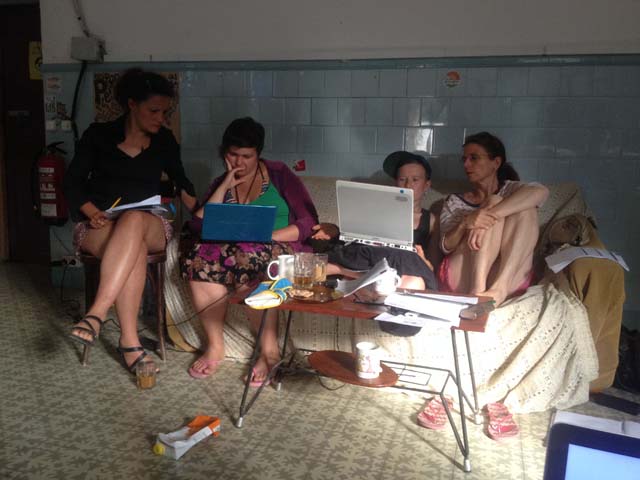
We focused primarily on drafting the common parts of the final report of the action, choosing to complete this report with:
- a practical manual of educational workshops created by each person, freely downloadable here
- a blog sharing progress reports on the action, and parallel or consecutive achievements carried out locally by each partner (provisional version here)
The second part of the seminar then quite naturally focused on the evolution of understandings and the diversity of appropriations of the framework initially proposed.
Two processes accompanied this part:
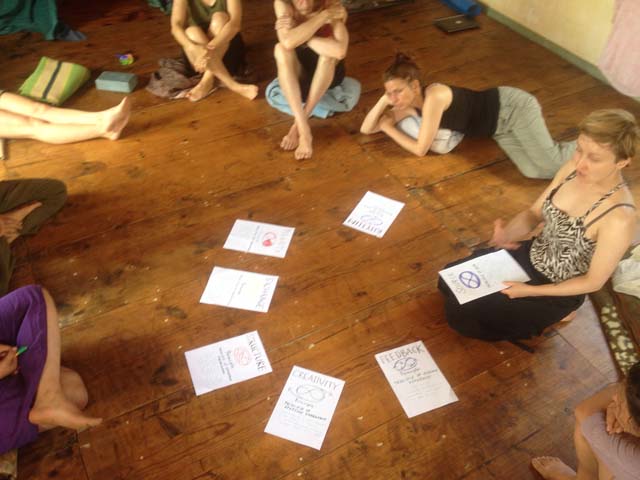
- the use of external speakers in the previous stages (X led warm-ups using theatrical animation techniques, Hélène Göhring produced the visual and sound documentation)
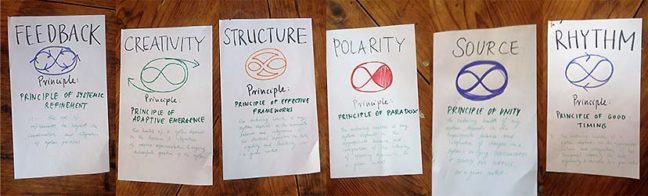
- the use of the Pattern Dynamic (TM) method which To.Pole demonstrated during the previous meeting.
In the eyes of the French partner, the main achievements emerging from this time of reflection and exchange are as follows:
Cultivate long-term connections
A large part of EEE was devoted to the discovery, sometimes surprising, of the differences in the conception of educational work between partners. This shared awareness, sometimes stormy, was one of the riches of the project.
It aroused the desire to deepen mutual knowledge between partners over the long term, in order to mature a minimum corpus on the identity and constraints of each, to validate with full knowledge of the modalities of action and choice of educational approaches on subsequent projects. This is in order to propose projects focusing more on operational aspects than conceptual ones. An approach supported by certain European Union measures
In this sense, GOercn, the only partner of EEE constituted as an open network, offered its colleagues to join in order to:
- continue the work of validating values and a common methodological framework
- pool strategic monitoring of European news
- engage in collaborative engineering on subsequent projects
This proposal made to individuals and not to structures particularly caught the interest of Daniel Hayes, representative of the Spanish partner PIC with whom a second production had also been carried out during EEE in the form of an educational game dedicated to the discovery of its place (Discovering Can Masdeu, photographic treasure hunt)
Going from multi to trans-disciplinary
Everyone found great wealth in meeting and discovering the specialties of their colleagues… while opting to refocus on their own during the final happening.
This first experience gives us the desire to push the work to the point of designing a truly trans-disciplinary approach, that is to say where various disciplines combine more intimately to arrive at achievements where they are inseparable.
Working closely with local contexts
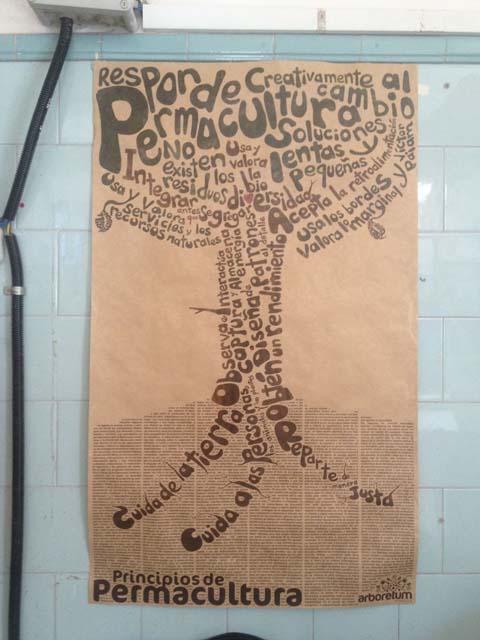
The meetings that took place during EEE were more or less focused on the external environment (discovery of specificities, local initiatives and partnerships, active visits, participation in public events, etc.)
The added value of an open option seems obvious to us and should be cultivated, whether for better local information on the existence of the project or for its own educational contribution.
Extend EEE achievements locally
EEE allowed the French partner to assert its European vocation in the intercultural education of youth, and gave it additional animation tools to share and bring to life locally.
This awareness is reflected in particular in:
- the educational workshop “the tree of hopes” and the “EAFE” exhibition structure experienced during EEE, and dedicated to environmental education
- a new educational workshop “European Words” dedicated to citizenship education designed in collaboration with the ph